
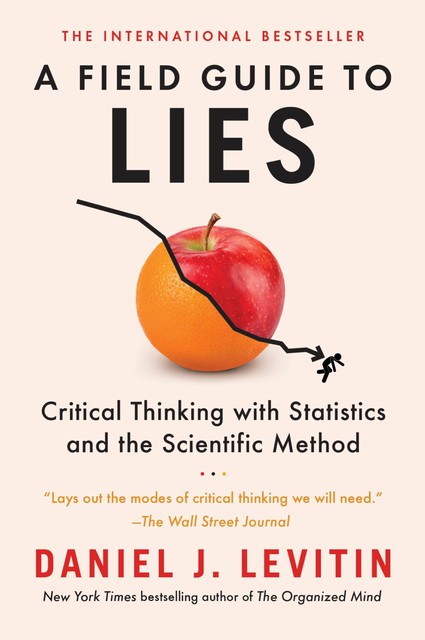
A Field Guide to Lies
- Über
- Ersteindruck1
- Zitate10
- Leser12
Dieses Buch ist zurzeit nicht verfügbar
369 Druckseiten
Ersteindruck
- Мариhat einen Ersteindruck geteiltvor 7 Monaten
 👍Lesenswert💡Viel gelernt🎯Lesenswert
Zitate
- Мариhat Zitat gemachtvor 7 MonatenAs Einstein reportedly said, if you know how it’s going to turn out, it’s not science, it’s engineering.
- Мариhat Zitat gemachtvor 7 MonatenThe great fictional detective Sherlock Holmes draws conclusions through clever reasoning, and although he claims to be using deduction, in fact he’s using a different form of reasoning called abduction. Nearly all of Holmes’s conclusions are clever guesses, based on facts, but not in a way that the conclusion is airtight or inevitable. In abductive reasoning, we start with a set of observations and then generate a theory that accounts for them. Of the infinity of different theories that could account for something, we seek the most likely.
- Мариhat Zitat gemachtvor 7 MonatenScientific progress depends on two kinds of reasoning. In deduction, we reason from the general to the specific, and if we follow the rules of logic, we can be certain of our conclusion. In induction, we take a set of observations or facts, and try to come up with a general principle that can account for them. This is reasoning from the specific to the general. The conclusion of inductive reasoning is not certain—it is based on our observations and our understanding of the world, and it involves a leap beyond what the data actually tell us.
Probability, as introduced in Part One, is deductive. We work from general information (such as “this is a fair coin”) to a specific prediction (the probability of getting three heads in a row). Statistics is inductive. We work from a particular set of observations (such as flipping three heads in a row) to a general statement (about whether the coin is fair or not). Or as another example, we would use probability (deduction) to indicate the likelihood that a particular headache medicine will help you. If your headache didn’t go away, we could use statistics (induction) to estimate the likelihood that your pill came from a bad batch.
fb2epub
Ziehen Sie Ihre Dateien herüber
(nicht mehr als fünf auf einmal)