
Your Brain Is Playing Tricks On You
- Sabin Chaulagainhat Zitat gemachtvor 3 Jahren
 human beings tend to blindly trust their perception, to the point of considering it to be shared by everyone.
 - Shizhat Zitat gemachtvor 3 Jahren
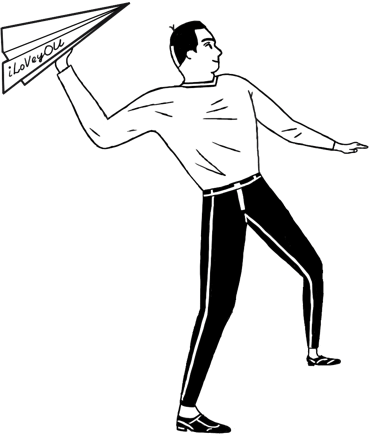
 Without thinking, does the black figure seem to be facing us, or does it have its back to us? Are you above it, or below? You’re hesitating…
Now look at the image below: the individual clearly seems to be facing us, their elbows leant on the barrier, and they’re located above you. And now that you have this image in mind, look at the first version of the image again. The interpretation you make of it will copy the scenario that image (a) led you to see, and now the black figure appears to be facing you at a low-angle shot - AURAhat Zitat gemachtvor 3 Jahren
 brain, which shelters our knowledge, operates through estimates. The outcome is that our knowledge of things and of the world is always relative.
 - mrirtaza2020hat Zitat gemachtvor 3 Jahren
 something unreal has just happened. This is what we call “magic”.
 - sharifaha141hat Zitat gemachtvor 3 Jahren
 perception goes through our senses first.
 - nrfarina19hat Zitat gemachtvor 3 Jahren
 “We don’t see the world as it is, but rather as we are
 - happpykatthat Zitat gemachtvor 14 Tagen
 When blind people think they can see
 - knjigoloskinjahat Zitat gemachtvor 3 Monaten
 In an era of social media and non-stop news, we have access to a plethora of information on every possible subject. It’s therefore easy to find material that supports our reasoning and that comforts our beliefs. This goes even further: on social media, we “follow” people who think like us and we look at their posts and news first, which reinforces our own convictions.
Interpersonal “bubbles” are thus formed, particularly on very ideologically sensitive subjects such as politics, religion, veganism, GMOs, protest movements such as the gilets jaunes in France, etc. This leads to an even greater polarization of our society and reduces our mental flexibility – in other words, our aptitude to change our mind and our capacity to integrate any new information we’re exposed to in the least biased way possible. If I’m pro-gilets jaunes, I’m only going to see police brutality and omit there are also violent acts perpetrated by people from my group. On the contrary, if I’m against the gilets jaunes, I’m going to focus on the violence of the rioters and demonstrators without seeing that a large part of them are pacifists and that the police is sometimes violent. - knjigoloskinjahat Zitat gemachtvor 3 MonatenHuman beings have a very strong penchant for everything that works in pairs: good and evil, left and right, hot and cold. Dualism is a mechanism to reduce ambiguity, which is applied to concepts too complex to comprehend other than reducing them to two definite and antagonistic realities.
- Patríciahat Zitat gemachtvor 4 Monaten
 The ambiguity of the signals received always puts us in an uncomfortable position of uncertainty. Thus, if our perception is missing an element to get rid of an ambiguity, our brain is going to want to fill that void.
fb2epub
Ziehen Sie Ihre Dateien herüber
(nicht mehr als fünf auf einmal)